Can Foreigners Use WeChat Pay in China?
Yes. A foreign Visa or Mastercard has linked directly to WeChat Pay since 2023, with no Chinese bank account involved. Here is what works, what it costs, and where it still breaks.
 Selina Chen 陈丽明 EN ⇄ 中文 · Expat guide
 Yes. Since July 2023 a foreign Visa, Mastercard, American Express, Discover, JCB or Diners Club links directly to WeChat (weixin, 微信), with no Chinese bank account involved at any point. Any guide still presenting that as a clever workaround is out of date.
What has not changed is that a foreign account is a restricted account. It pays merchants beautifully and does almost nothing else. This page is about that gap. The click-by-click walkthrough for both wallets lives in our guide to using WeChat Pay and Alipay in China; the wider arrival admin sits in the China travel checklist.

Why you need WeChat Pay in China
Not because China is a cash economy. It is the opposite problem. Almost every payment terminal in the country runs on UnionPay rails, and a Visa or Mastercard issued abroad does not route over those rails, so handing the physical card to a cashier fails nearly everywhere outside international hotels, airports and high-end retail. The QR code is the till.
Skip the setup and you spend a week paying cash while everyone in the queue behind you taps a phone. It also covers the metro turnstile, the shared bike, the cup of coffee, and the vendor who has never owned a card reader.
The other half of the problem A wallet solves the paying. It does not solve the cashier who cannot tell you why the payment was refused, or the supplier quoting a price you have no way to check. That is a different job, and it is ours.Can foreigners use WeChat Pay in China without a Chinese bank account?
Yes, and this is the change that made the app usable for visitors. WeChat Pay accepts foreign cards on seven networks: Visa, Mastercard, American Express, Discover, JCB, Diners Club, and UnionPay cards issued outside the mainland. Identity is verified against your passport. No Chinese ID, no Chinese bank account, no local address.
What you do need is a physical card in your own name, a passport, and a phone number that can still receive your bank’s SMS codes. Virtual and prepaid cards are refused. The name on the card, the name in the passport and the name on your WeChat profile all have to match, in the same order, or verification keeps failing without ever telling you why.
Setting it up, and the steps that trip people up
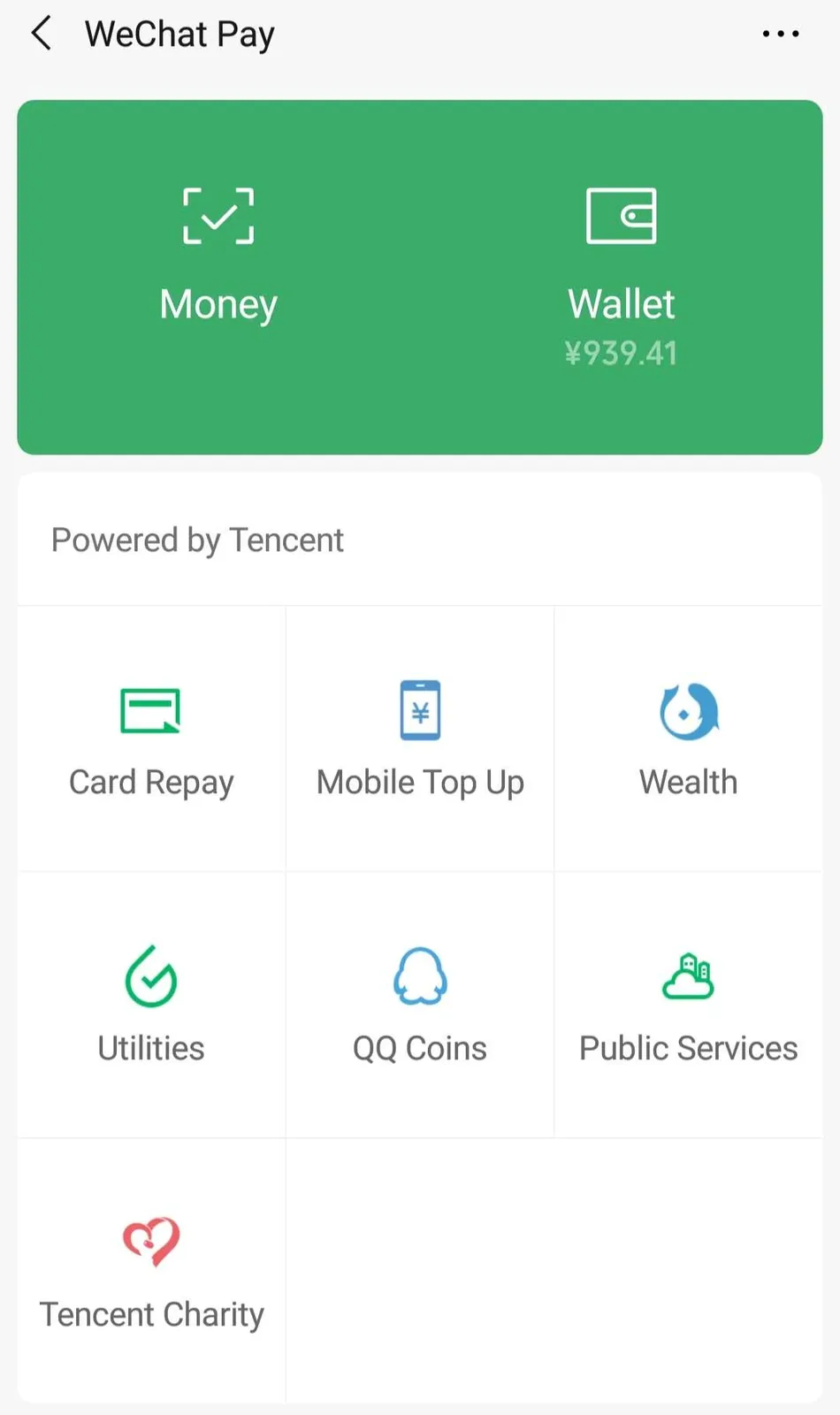
The path inside the app is Me > Services > Wallet > Bank Cards > Add a Bank Card. Some builds label the middle item “Pay and Services.” Older guides send you to Me > Wallet, which has not been the route for years and is why people conclude the feature is not there. The rest is form filling: service agreement, identity details, card number and billing address, six-digit payment password.
The failures are the part worth your attention.
- Region. At registration, choose your home country, not China. This is the one mistake that is genuinely awkward to undo.
- The passport photo. Shoot the photo page flat, in daylight, whole page in frame, no glare on the machine-readable zone. Most rejections come down to lighting rather than anything being wrong with the passport.
- Your bank. A first-ever charge from a Chinese payment platform is exactly the pattern fraud systems block. Tell your issuer before you fly. When a binding fails once, the decline usually came from your own bank, not from Tencent.
- The SMS. The code goes to the number your bank holds on file, which is your home number. A China eSIM will not receive it.
- VPN. Hopping between countries and IP addresses mid-setup trips WeChat’s risk controls.
Do all of it before you land, while your own SIM works and your bank is open.
What it costs a foreigner to pay this way
Linking is free. Payments of CNY 200 or less carry no service fee at all. Above CNY 200 the wallet takes 3%, and that threshold is per transaction rather than a daily total, so street food, metro fares, taxis and convenience stores cost you nothing while hotels, train tickets and a proper dinner do. Both platforms run new-user promotions waiving the 3% for a limited window, so check what is live when you link the card rather than trusting a figure from an older article.
Your card issuer’s foreign transaction fee, typically 1% to 3%, stacks on top. If you own a card without one, this is the trip to bring it on. You are billed by your own issuer in your own currency, and the conversion happens on your bank’s side at your bank’s rate. The card side of all this is covered properly in what credit cards are accepted in China.
Limits, and what a foreign card still cannot do
In March 2024 the People’s Bank of China directed the platforms to raise the single-transaction ceiling for foreign nationals from USD 1,000 to USD 5,000, and the annual cumulative limit from USD 10,000 to USD 50,000. Ant Group implemented it for Alipay and WeChat Pay matched. Those are still the standing limits. Figures like “6,500 yuan per transaction” and “65,000 yuan a year” are still published by guides date-stamped 2026. They are the old USD 1,000 and USD 10,000 caps converted at an exchange rate nobody uses any more.
The restrictions that will actually reach you are the social ones. A passport-verified account on a foreign card is a spending account:
- You cannot top up the WeChat balance, the 零钱 wallet locals pay each other from.
- You cannot send transfers or red packets. Splitting a bill with the person across the table is off the menu.
- Anything that does reach that balance stays in China. It will not come back out to a foreign card or an overseas account.
- Your own receive-payment code, the one small vendors use, needs a Chinese bank card.
If you are moving to China rather than visiting, a Chinese bank account is still the thing that unlocks the whole app.
Where WeChat Pay still fails a foreigner
Declines have not disappeared. Individual merchants and mini programs can be configured in ways that reject foreign-linked cards while your account works perfectly, and the app rarely tells you which side refused. Rail booking is the reliable sore point: foreign card declines on 12306 are common enough that experienced travelers pay through the wallet rather than typing the card into the site, or book through an agent.
The rest is physical. A dead phone is a dead wallet, and a rural stall with no signal is a cash transaction, so keep a few hundred yuan in small notes.
Hong Kong and Macau are a separate wallet
The mainland service is Weixin Pay. WeChat Pay HK is a different wallet, holding Hong Kong dollars, for Hong Kong users. Regional wallets are independent and funds cannot move between them, so setting up one does not give you the other. WeChat Pay HK spends in the mainland and in Macau, but the convenience is not symmetric, and a mainland setup will not solve a Hong Kong trip.
The honest verdict
Yes, foreigners can use WeChat Pay in China, and the question stopped being interesting in 2023. A foreign card links in about ten minutes, works at essentially every merchant a visitor will meet, and costs nothing below CNY 200. What is left is small stuff: a name typed in the wrong order, a bank that blocks the first charge, a red packet you cannot send back.
Set it up before you fly, install Alipay as well because plenty of counters display only one code, and keep cash for the day your phone dies. Do that and the payment half of traveling in China stops being something you think about, which frees you up to be confused by everything else instead. That has its own literature: culture shock in China, and the honest ledger of living in China.
Your dates. My quote.
Twelve hours.
Send your cities, dates and product list. You'll get a fixed written quote, no obligation, no deposit to ask.
superinterpreter · selina@mychinainterpreter.com · Xiamen, China · UTC+8