Juneyao Airlines Review - Flight Ratings
Routes Twin Shanghai hubs and close to 100 destinations across 15 countries and regions, including seven intercontinental 787-9 routes: Helsinki, Athens, Manchester, Brussels, Milan, Sydney and Melbourne.
 Selina Chen 陈丽明 EN ⇄ 中文 · Frequent flyer · Trade & sourcing
 - A genuine lie-flat business class on the 787-9, 1-2-1, every seat on the aisle
- Seven intercontinental 787-9 routes, six of them from Shanghai, including Manchester, Brussels, Athens and Helsinki
- Star Alliance Connecting Partner since 2017, and openly chasing full membership in 2026
- A full 7 out of 7 safety score from AirlineRatings, and 92% on-time through 2025
- Economy carry-on is one piece at 5kg, well under the 7kg to 8kg most carriers allow
- Skytrax rates it 3-Star and names cabin crew English and the website as the weak points
- A thin entertainment library, the weakest-scoring part of the onboard product
- Booking and check-in can insist on a mainland Chinese phone number
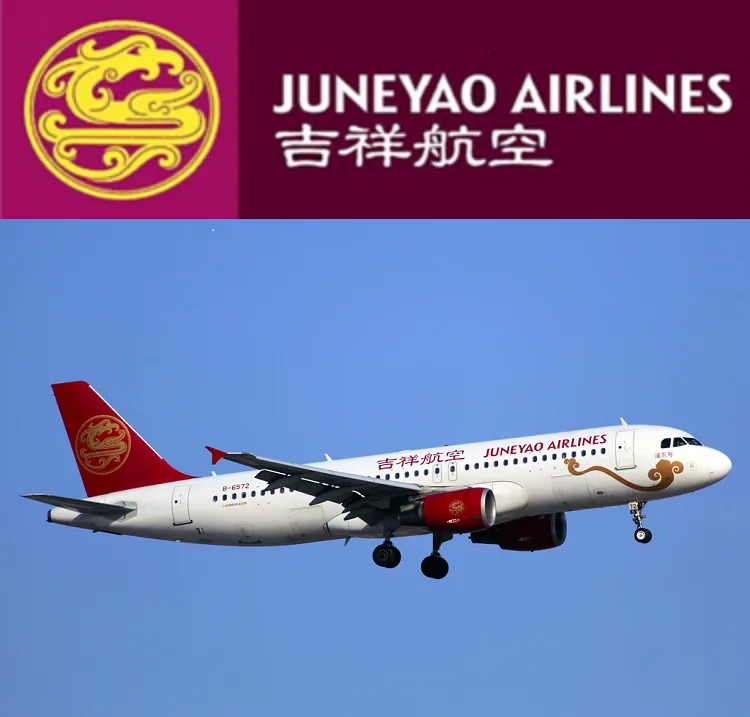
Our Juneyao Airlines review: what you are actually buying
Most of what gets written as a Juneyao Airlines review stops at “a Chinese carrier you have not heard of.” That is the least interesting thing about it. Juneyao Air was founded on 30 June 2005, flew its first service in September 2006, and now operates 103 aircraft: 93 Airbus narrowbodies and ten Boeing 787-9 Dreamliners that reach Helsinki, Athens, Manchester, Brussels, Milan, Sydney and Melbourne. Skytrax certifies it 3-Star. AirlineRatings scores it 7 out of 7 for safety.
The number that tells you most, though, is five. Five kilos is your free carry-on in economy, on every route, domestic or intercontinental. Juneyao spends where a paying passenger can see it, on a real flat bed and a modern widebody fleet, and economizes hard everywhere else.
Who owns Juneyao, and why it is not a budget airline
Juneyao is one of the few Chinese carriers of any size that is not state controlled. The Juneyao Group holds about 44%, China Eastern’s investment arm is the second largest shareholder on about 12%, and the rest trades on the Shanghai Stock Exchange under 603885. That stake came out of a 2019 cross-shareholding deal, which is why you find Juneyao codeshares sitting alongside the flag carriers rather than fighting them.
Do not read “private” as “low cost.” Juneyao calls itself a high value carrier: full service quality on a disciplined cost base, and it says openly that it will not join price wars. It does run a budget airline, under a different name: 9 Air, based in Guangzhou with 26 Boeing 737s, flying since January 2015. If a Juneyao itinerary suddenly feels like a low-cost operation, check which of the two brands is actually flying the sector.
Star Alliance Connecting Partner, not a member
Juneyao joined Star Alliance on 23 May 2017 as a Connecting Partner. That is not membership. A Connecting Partner is stitched into Star Alliance itineraries so a booking that combines Juneyao with a member airline behaves as one trip, but Juneyao does not sit at the table as a member and its flights do not behave like member flights across the whole program.
It is now the only airline in that category, and the reason is worth knowing so you can see when the claim would stop being true: Thai Smile, the only other Connecting Partner, ceased operations on 31 December 2023 and was folded back into Thai Airways, leaving Juneyao alone. The airline has made no secret of wanting the upgrade and has been publicly targeting full membership in 2026, its twentieth year. Until that lands, plan your mileage earning and your through-checked bags rather than assuming them.
Hongqiao, Pudong, and where the long-haul flights leave from
Juneyao runs two Shanghai hubs and confusing them costs you a day. Hongqiao is the narrowbody base, the airport closest to the city, handling the domestic and regional Airbus network. Pudong is where the 787s live, and every intercontinental route departs from there with one exception. The two airports sit on opposite sides of Shanghai, so a self-connection between them is a transfer, not a walk.
The intercontinental network is seven destinations. Out of Pudong: Helsinki five times a week, Athens five, Manchester three, Brussels three, Sydney four, Melbourne three. The exception is Milan, which flies twice weekly from Zhengzhou rather than Shanghai. The Zhengzhou to Helsinki service is finished; its last bookable flight was 25 February 2026 and reservations closed that March. Manchester goes daily from 5 December 2026 to 10 January 2027, and Sydney and Melbourne each go daily for about a month from late January 2027.
The network as a whole runs to close to 100 destinations across 15 countries and regions, the great majority of them mainland Chinese cities, with secondary bases at Nanjing Lukou, Beijing Daxing and Wuxi. The first intercontinental flight, Shanghai to Helsinki in June 2019, made it the first private Chinese airline to fly a widebody intercontinental route.
Cabin, seats and legroom
The fleet is two-cabin throughout. There is no first class on any Juneyao aircraft, whatever the fare rules imply, so business is the top of the product.
On the 787-9 that cabin is the real thing: 29 Thompson Vantage XL seats in a 1-2-1 layout, every one with direct aisle access, 22 inches wide, folding fully flat at 180 degrees into a 78-inch bed, with an 18-inch touchscreen and universal AC and USB-A power. The footwells alternate left and right row by row. Reviewers who boarded expecting a second-tier Chinese product have come off surprised by the hardware.
Economy on the same aircraft is 266 seats at 3-3-3, Recaro CL3710 shells with adjustable headrests, roughly 32 inches of pitch and up to six inches of recline. Nothing is boxed under the seat in front, so the footwell stays clear. That is standard for the class rather than generous. Check the seat map before you choose, because the 787 fuselage has positions where the window simply is not there.
The narrowbodies carry eight business seats in a 2-2 arrangement behind a movable curtain, so that cabin grows and shrinks with demand. A320s seat 156, A321s 190, A321neos 199.
Food and cabin service
Service is where the 3-Star rating comes from, and the criticism is specific rather than vague. Skytrax grades cabin staff and ground staff alongside the seat and the catering, and it names two weaknesses outright: the website, and the cabin crew’s English.
Catering in long-haul economy is one hot meal on a medium sector, a choice of two mains, plus nuts, biscuits and a juice pack. Competent, unremarkable food. What passengers notice is what follows. On at least one Singapore run there was no further drinks service once the trays had gone, and a blanket had to be asked for, though the pillow, earpiece and safety card were waiting at the seat.
The crew are warm at the door and scarce at cruise. Announcements can be hard to follow over the cabin speakers. None of that is disqualifying and it is roughly what the fare buys, but if you are flying in to negotiate the next morning, plan for sleep rather than for service.
In-flight entertainment and Wi-Fi
The 787-9 runs Panasonic eX3 gate to gate, an 11.6-inch touchscreen in economy and an 18-inch one in business. The hardware is good and the library is not. Expect recent blockbusters and little depth, with series often carrying a single season. The genuinely good part is the 3D moving map and the external tail and nose cameras, which beat most of what is loaded alongside them.
Connectivity on the 787-9 is Panasonic eXConnect Ku-band. Getting onto it is another matter: one reviewer was handed the login instructions on board and never managed to connect. AirlineRatings’ passenger scores rate entertainment below every other category they measure on this airline. Download what you need before you board and treat anything that works in the air as a bonus.
Baggage allowance
The carry-on rule is the strictest thing about this airline and it is identical on every route, domestic and international. Economy gets one piece at 5kg. A business ticket gets two pieces at 8kg each. Every piece has to fit 55 x 40 x 20cm, with the three dimensions adding up to no more than 115cm. Most carriers allow 7kg or 8kg in economy, so this is the rule that catches people, and anything over the limit goes into the hold at check-in with an excess charge if it pushes you past your allowance.
Checked baggage on domestic Chinese sectors runs on the weight concept: 30kg in business, 20kg in economy, no single piece larger than 100 x 60 x 40cm or heavier than 50kg. An infant without a seat gets no allowance but does get a free folding stroller.
International allowances are not published in that table and vary by route, so read what your fare actually includes rather than assuming the domestic numbers carry over. Older write-ups quote a first class allowance. There is no first class to quote.
Safety record and punctuality
AirlineRatings gives Juneyao a full 7 out of 7 for safety, its top score. Through 2025 the airline carried more than 27 million passengers at a 92% on-time rate, which puts it near the front of the Chinese domestic field. Punctuality is the part of an airline’s operational record a business traveler actually feels, and this is a good one.
The episode worth knowing is old and it is ugly. On 13 August 2011, flight HO1112 was instructed six times by air traffic control to give way to Qatar Airways QR888, a Boeing 777 that had declared a mayday with five minutes of fuel left. Juneyao’s captain refused, claiming he had four minutes himself. The investigation found he had 42. Both aircraft landed safely. The Civil Aviation Administration of China revoked the captain’s license, barred him from operating in the country and referred the case to South Korean authorities. The first officer was suspended for six months, and the airline lost 10% of its flight operations for three months and was frozen out of new route applications for the same period. It was fifteen years ago and the penalties were served, but it is the most cited thing about this carrier and you should hear it here rather than find it later.
Is Juneyao Airlines worth it?
Yes, with the cabin you sit in doing most of the deciding. Business class on the 787-9 is a properly good product at a price the flag carriers do not match, and if you are flying Manchester, Brussels, Athens or Helsinki into Shanghai for work, it is a serious option rather than a compromise. Economy is fine and no more: a modern aircraft, a standard seat, one meal, a thin film library, and a crew who will leave you alone.
Book it knowing three things. The 5kg carry-on limit is real and it is enforced. The website and app are the weakest part of the operation, so leave time for booking and check-in and expect to be asked for a Chinese phone number. And Connecting Partner is not membership, so do not assume your Star Alliance status behaves the way it does on United or Lufthansa. Safe travels.
Flying Juneyao on a sourcing run through China? Book a Chinese interpreter before you land so supplier meetings and factory visits don’t get lost in translation.
Booked on Juneyao Airlines? Now book the meetings.
Send your cities, dates and supplier list. You'll get a fixed written quote for interpreting and on-the-ground sourcing, no obligation, no deposit to ask.
superinterpreter · selina@mychinainterpreter.com · Xiamen, China · UTC+8