China Tourist Visa: Who Needs One and How to Apply
Most of what is written about the China tourist visa describes rules that have already been replaced. Around 50 nationalities no longer need one at all. Here is who still does, what the L visa costs, and how the application actually works.
 Selina Chen 陈丽明 EN ⇄ 中文 · Travel guide
 Most guides to the China tourist visa still describe a country that wanted your flight bookings, your hotel confirmations and a printed itinerary before it would consider letting you in. That country stopped existing on 1 January 2024. Around 50 nationalities now walk into the mainland with nothing but a passport, and for everyone else the paperwork got shorter. So the first question is not how to apply. It is whether you need to.
Do you need a China tourist visa at all?
There are three ways into mainland China and only one of them involves a consulate.
Visa-free for 30 days. China runs a unilateral visa-free program that covered 50 countries as of 17 February 2026, the day the United Kingdom and Canada were added. Ordinary passport holders from those countries enter for tourism, business, family visits or transit and stay up to 30 days per entry. No form, no fee, no appointment. The program started in December 2023 with France, Germany, Italy, the Netherlands and Spain, picked up Russia in September 2025 and Sweden in November 2025, and now reaches most of Europe plus Japan, South Korea, Australia, New Zealand, the Gulf states, Brazil, Argentina, Chile, Peru and Uruguay. It is authorized through 31 December 2026.
The United States is not on that list. Neither is India, Vietnam, the Philippines, or most of Africa.
Visa-free for ten days in transit. The other way in is the 240-hour visa-free transit scheme, which covers around 55 countries and does include the US, at 65 ports across 24 provinces, regions and municipalities. One condition, strictly enforced: you must be traveling on to a third country or region, with the onward ticket already booked. New York to Shanghai to Seoul qualifies. New York to Shanghai to New York does not. Inside the window you may cross provincial boundaries within the permitted areas, and you do not have to leave from the port you arrived at.
Everyone else applies. If your passport is on neither list, or you want longer than 30 days, or you are flying home the way you came, you need a visa. For a holiday, that means the L.
One thing to settle before you start: a mainland visa is not valid for Hong Kong or Macau. Both run their own immigration, most Western nationals enter them visa-free, and every crossing back into the mainland counts as a fresh entry.
What the L visa is, and what it is not
China issues 12 ordinary visa categories. L is the tourist visa: sightseeing, leisure, seeing the country because you want to see it. M is the business visa, and it covers meetings, negotiations, factory visits and trade fairs, which is not the same trip even when it looks like one from the outside. Consulates reject applications where the category and the stated purpose do not line up, and “I put tourism because it seemed simpler” is exactly the mismatch they are looking for.
An L visa is normally issued for 30 to 60 days per entry, in single, double or multiple-entry form. US citizens are routinely given a 10-year multiple-entry L visa, which is widely misread: the visa is valid for ten years, but each individual stay is still capped at whatever the officer stamps on arrival. Validity and duration of stay are two different numbers on the same sticker. Validity runs from the date of issue to 24:00 Beijing time on the expiry date. Duration of stay is the clock that starts when you land.
The documents a China tourist visa application needs
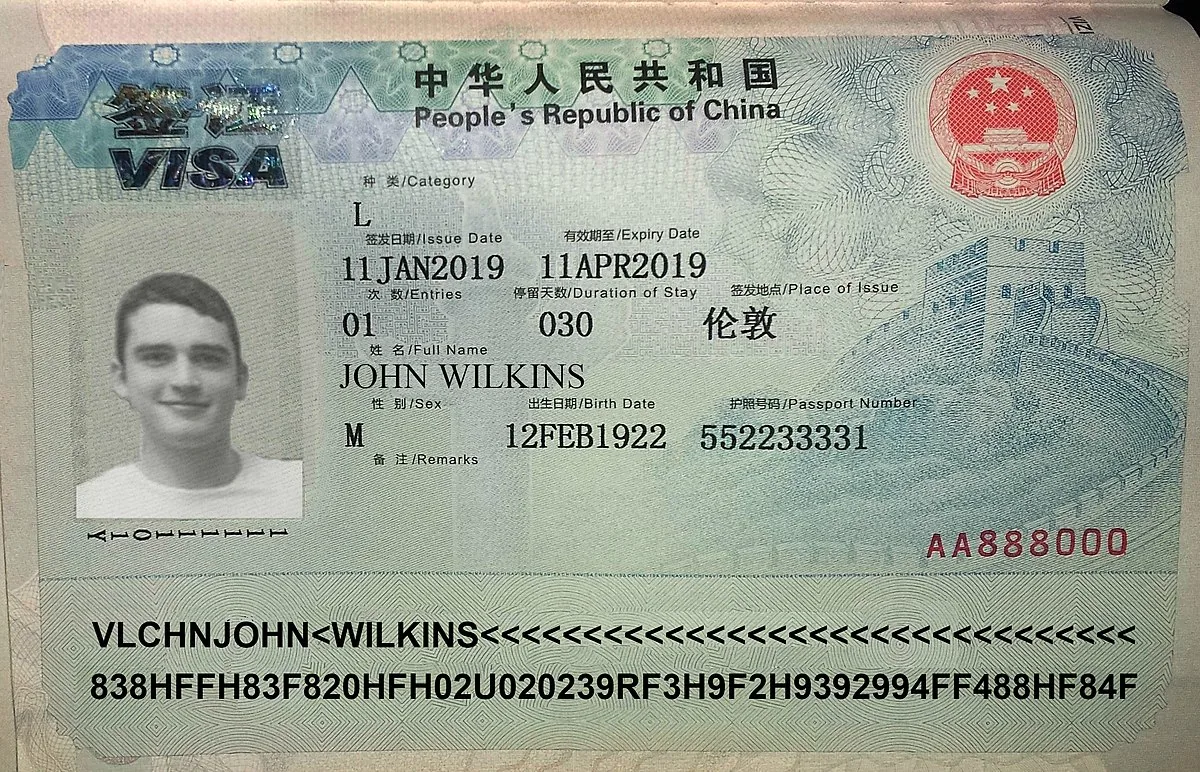
The core list is short:
- Passport with more than six months of validity remaining and at least two blank visa pages
- The application form, completed in the online system, then printed and signed
- One recent photo, 33mm x 48mm on a white background, taken within the last six months and meeting the full Chinese visa photo requirements
- Proof of residence if you are applying somewhere other than your country of citizenship: a green card, a resident visa, a driver’s license, a utility bill
- Your most recent Chinese visa or residence permit, if you have ever held one
- Original supporting paper for a name change, or for Chinese nationality previously held
What is no longer on that list matters more than what is on it. Since 1 January 2024, tourist visa applicants have not been required to submit round-trip air ticket bookings, hotel reservations, an itinerary or an invitation letter. Most guides still list all four, which is how people end up buying non-refundable flights to support an application that never asked for them. Consular officers still assess case by case and can request more, so keep your plans coherent. Just do not buy the trip to prove you deserve the visa.
How to apply for a China tourist visa
- Fill in the form online. The New COVA system at consular.mfa.gov.cn/VISA went live on 30 September 2025 and replaced the old one. Complete it, then print and sign it.
- Submit in person, or send someone. Where a Chinese Visa Application Service Center exists, that is where applications go. Otherwise it is the embassy or consulate covering your district. Chinese missions in the United States do not accept applications by mail, but you do not have to appear yourself: a friend, a relative or a visa agency can lodge the file for you.
- Fingerprints, usually not. At visa centers, applicants between 14 and 70 normally give fingerprints. A waiver covering short-stay applications of up to 180 days, which takes in the L visa, runs from 17 December 2025 to 31 December 2026. Chinese missions in the US do not collect fingerprints at all, though a consular officer can still call an applicant in for an interview.
- Pay when the office says to, not before. Chinese missions in the United States take the fee on the day you collect the passport. A visa application service center takes it, plus its own service fee, the moment it accepts the file. Neither hands it back afterwards.
- Collect the passport. Four business days at standard speed.
Apply about a month before you travel. Not because the process is slow, but because a refusal you have time to fix is an inconvenience, and a refusal three days out is a canceled trip.
The visa is not the last form. Since 20 November 2025 the paper landing card has been replaced by an online arrival card you file before you fly.
What a China tourist visa costs
Two different price scales exist, and which one applies to you is decided by the passport you hold rather than the visa you asked for. Read any official fee table by column, and find your nationality before you read a number.
At the Chinese embassy and consulates in the United States, a US citizen pays a flat $140 for an L visa. Single entry, double entry, six-month multiple entry, twelve-month multiple entry: all $140. The number of entries makes no difference to the price, so there is no saving in asking for fewer than you might use. A non-US citizen applying at those same offices pays a tiered fee instead: $23 single entry, $34 double, $45 for six-month multiple, $68 for twelve-month multiple. Both columns are reduced rates, and the reduction runs to 31 December 2026.
Speed costs extra. Express service is two to three business days for $25 more. Rush service is next business day for $37 more, and it is granted only in real emergencies. Where a visa application service center handles the file rather than the consulate itself, the center charges its own service fee on top of the visa fee.
Do Filipinos need a visa for China?
Yes, without exception. The Philippines is not among the 50 countries with 30-day visa-free entry, and it is not among the 55 countries on the 240-hour transit list either. There is no Philippine passport itinerary into the mainland that skips the visa, and anyone telling you China is visa-free for Filipinos is describing somebody else’s passport.
Since 29 January 2024 the Embassy in Manila has not accepted applications from ordinary passport holders directly. They go to the Chinese Visa Application Service Center at 6/F Noble Square, 6762 Ayala Avenue, Makati City. Diplomatic and service passports still go to the Embassy. There are also consulates in Cebu, Laoag and Davao.
A single-entry tourist visa on a Philippine passport starts at around PHP 2,900 at regular speed, with the center’s service fee already included in that figure. The express and rush tiers cost meaningfully more. Regular processing is four working days. For comparison, a US passport holder applying in Manila pays upwards of PHP 9,700, because the $140 reciprocity fee follows the American passport wherever it is presented.
Where applications go wrong
- Buying the trip first. Book refundable, or book after the visa is issued. The application does not need the bookings, and a refusal does not refund them.
- Choosing L for a working trip. If you are visiting suppliers, walking a trade fair or negotiating anything, M is the honest category and the one that survives scrutiny.
- Assuming a mainland visa covers Hong Kong. It does not, in either direction.
- Applying when you did not have to. Check your nationality against the 30-day list before you spend a fee and an afternoon.
The short version
Check the list first. Around 50 nationalities enter mainland China for 30 days with no visa at all, and around 55 get ten days in transit if they are continuing to a third country. If you fall outside both, the tourist visa is an online form, a photo, a passport and one visit to a service center, and it is a flat $140 on a US passport. Sort it out before you book anything you cannot cancel.
Quick answers.
How much does a China tourist visa cost?
How long does a China tourist visa take to process?
Do I need flight and hotel bookings to apply for a China tourist visa?
How long can I stay in China on a tourist visa?
What size photo does a China tourist visa application need?
Is a China tourist visa valid for Hong Kong and Macau?
Your dates. My quote.
Twelve hours.
Send your cities, dates and product list. You'll get a fixed written quote, no obligation, no deposit to ask.
superinterpreter · selina@mychinainterpreter.com · Xiamen, China · UTC+8